Calculations
Overview
The calculations in Surface Solutions are the central tool for performing all computations for your coating projects efficiently, consistently, and transparently. They make it possible to manage offers, positions, and items in a structured way, carry out calculations automatically, and apply individual adjustments.
With the calculations, you can:
The calculations are modular in structure and consist of several areas:
Thus, the calculations provide an end-to-end solution that covers everything from defining the calculation logic and managing items to creating calculations and offers.
By combining the overview, editor, definition, and item database, it is ensured that calculations can be performed accurately, transparently, and flexibly—regardless of how complex the items or orders are.
Calculation Overview
The Calculation Overview is the central entry point in Surface Solutions.
Here, you can see all existing calculations in a clear card view.

Structure of the Overview
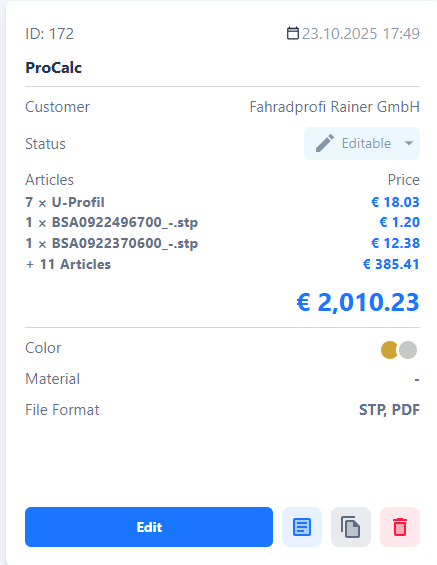
Each calculation is displayed as a card.
A card shows the most important information about the respective calculation at a glance:
-
Name of the calculation
-
Creation date
-
Customer
-
Items included in the calculation
-
Additional details (e.g., status or internal notes)
The cards are designed so that all relevant information can be quickly recognized without having to open the calculation.
Create New Calculation
At the top right of the Calculation Overview is the "Create Calculation" button.
You can use this button to create a new calculation.
This step is typically performed when a new customer request is received.
After clicking, the input form opens, where you can enter all relevant information for the new calculation.
Calculation Editor
The Calculation Editor is the heart of Surface Solutions.
Here, new calculations are created, edited, and managed.
The editor provides a detailed overview of all relevant information, customer and item data, as well as the ability to configure positions and surcharges individually.
Header in the Calculation Editor
In the upper section of the page (overview row), the most important general information is displayed:
-
Creation date of the calculation
-
Status
-
Name of the calculation
-
Total price (top right)
Once a calculation is completed, the "Create Offer" button also appears at the top right.
This button is available when a customer has already been assigned to the calculation and at least one position exists.

The Create Offer function is described in detail in the Offers chapter.
Overview of the Calculation
Below the overview row, the general information about the calculation is displayed.
Customer Data (left)
On the left side, the customer data is displayed.
Using the "Edit Customer" button, you can view and adjust all information related to the customer:
-
Company Name
-
Address
-
Contact Person
-
Email Address and Phone Number
-
Tax Information (e.g., VAT Identification Number)
If a customer already exists in the system, it is sufficient to enter the first few letters of the name.
The system will then automatically suggest matching customers, which can be selected.
Using the "Create New Customer" button, you can also create a new customer directly within the Calculation Editor.

Additional Options (right)
On the right side, various functions are available:
-
Download CSV – Exports all information recorded in the calculation.
-
Manage Attachments – Allows uploading and downloading files, such as drawings or additional information.
-
Surcharge Fields – These fields apply to the entire calculation and include values such as:
-
Number of color changes
-
Total material costs
-
Total discount or total surcharges
-
Setup costs
-
Other flat-rate cost components
-
These fields affect the total price of the calculation, not individual positions. You can adjust these fields independently in the calculation definition.

Positions in the Calculation
Below the general information, all positions of the calculation are displayed.
Each position corresponds to a single item to be coated.
Add New Position
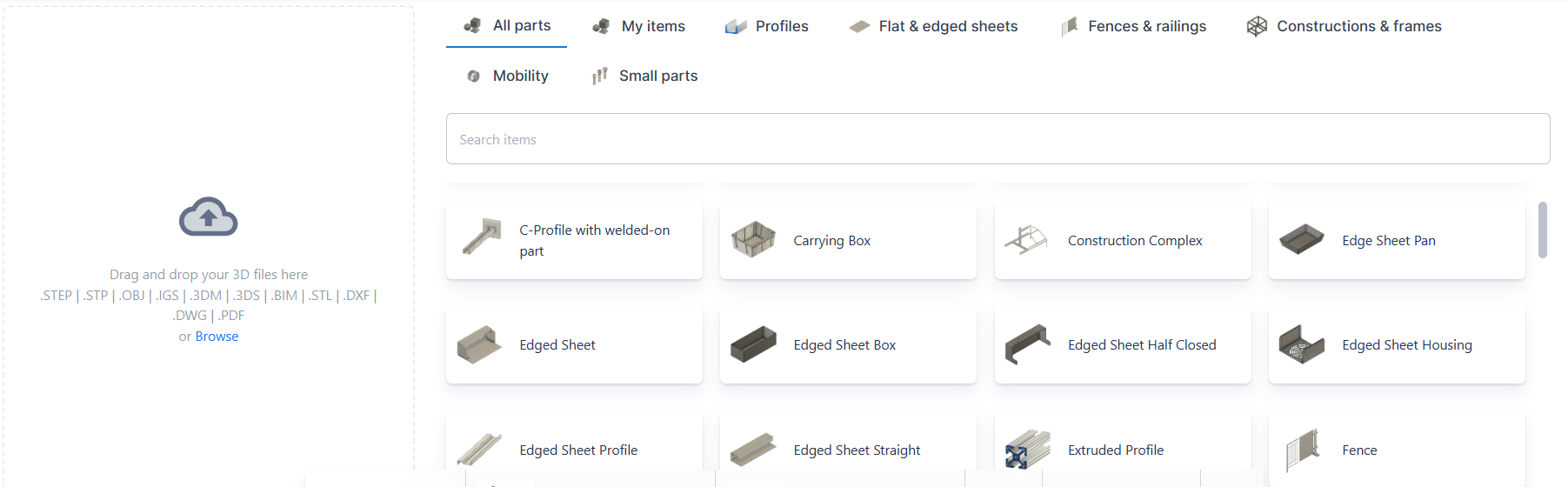
You can create a new position in two ways:
- Via Drag & Drop
Upload a 3D file or a technical drawing (e.g., in PDF format) directly into the position element. - From the Item Database
Select an existing standard item from the internal item library.
It already contains numerous predefined items in various categories.
You can also add your own items and assign individual calculation rules to them.
Structure of a Position
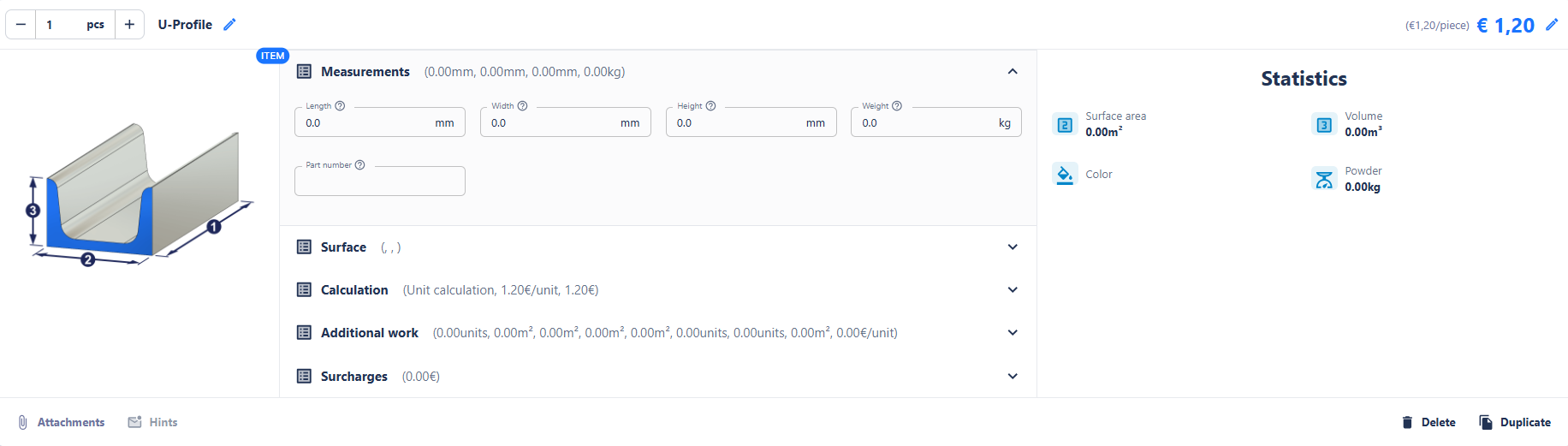
A position consists of several sections:
-
Top Left: Quantity and position name
-
Top Right: Total price of the position
-
Center: Input fields (e.g., length, width, height, color, weight, item number, surcharges, etc.)
-
Right: Position statistics (e.g., surface area, volume, color, powder quantity)
-
Bottom Left: Notes (messages definable via the calculation definition)
-
Bottom Right: Buttons to duplicate or delete the position
Using the pencil icon, all values can be adjusted manually.
This also applies to automatically calculated values—the user always has the option to override results individually.
Notes
In the Notes section, rules or informational messages can be stored, which appear automatically when certain conditions are met.
Example:
"Warning: The item exceeds the maximum size of the coating system."
This function is designed to alert users to potential limitations or special considerations in the calculation.
Editing Functions
-
Duplicate: Creates an identical copy of the position, which can then be adjusted.
-
Delete: Completely removes the position from the calculation.
Calculation Definition
The Calculation Definition in Surface Solutions is the central tool for designing the calculation logic for all calculations in your company. It allows you to create individual calculation models, define fields and formulas, and set up notes that are displayed in the Calculation Editor. With the Calculation Definition, you can ensure that all calculations are performed consistently, transparently, and flexibly.
Access to the Calculation Definition
You can access the Calculation Definition via the menu item "Tools & Settings" → "Calculation Definition".
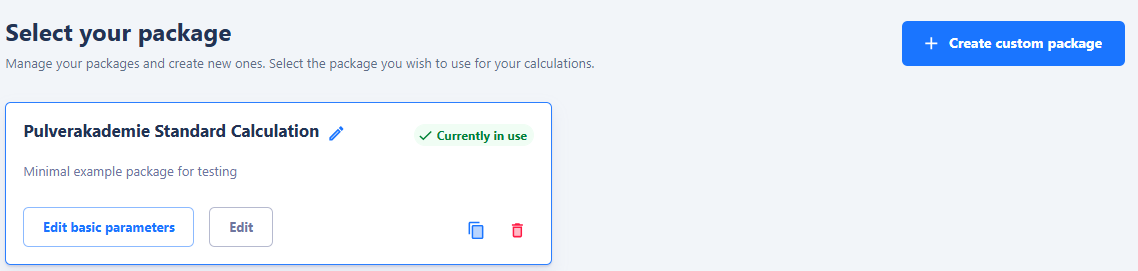
After opening it, you will see an overview of all existing packages. A package contains the complete calculation logic applicable to specific items or calculation scenarios.
Packages are valid across the entire organization, meaning all users within your organization access the same packages. This ensures that calculations are performed consistently, regardless of which user creates or edits the calculation.
Packages
A package forms the basis for a calculation and contains all the information necessary for the computation: templates, fields, formulas, and notes.
Packages can be either standard packages, which are already provided by Surface Solutions, or custom packages. Custom packages are suitable for capturing the specific requirements of your company.
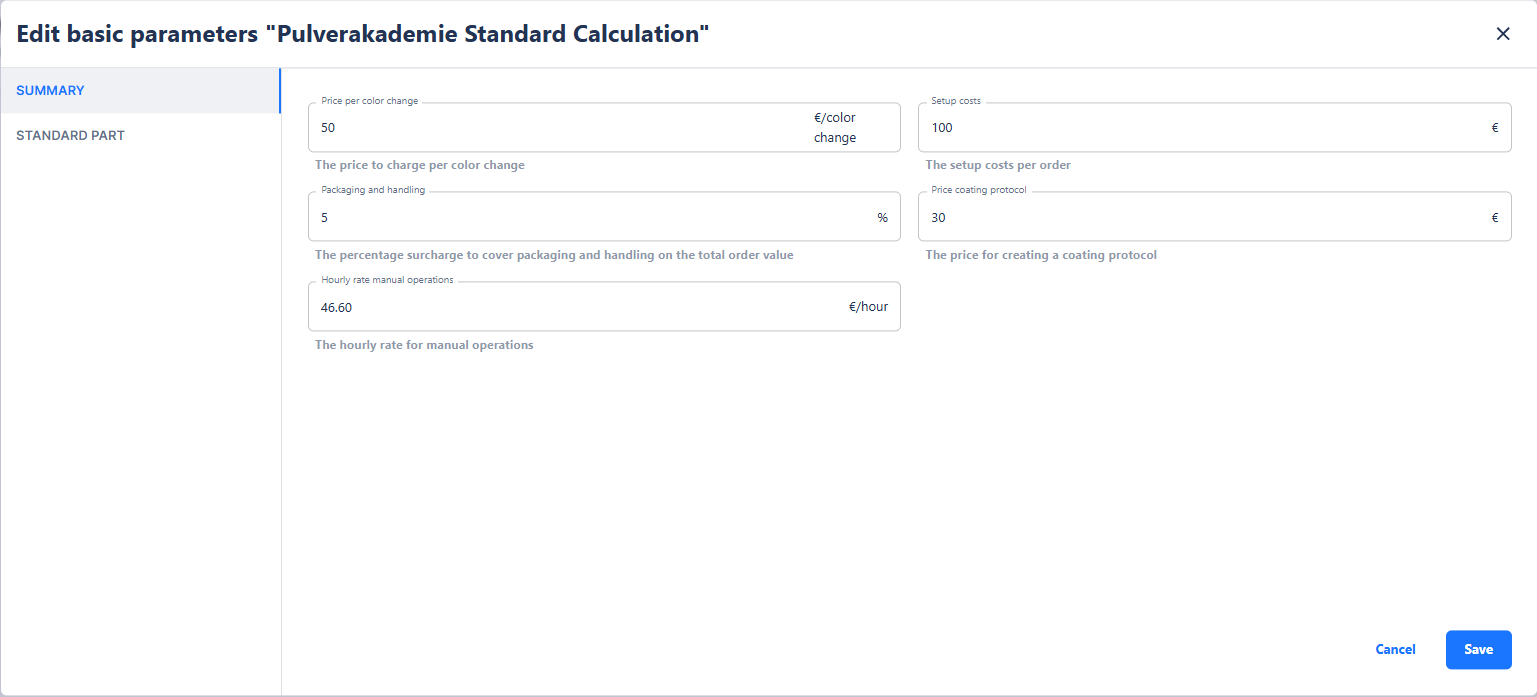
Adjust Basic Data
For each package, you have the option to quickly edit predefined values using the "Adjust Basic Data" button. This includes, for example:
-
Base price per unit
-
Price per square meter
-
Price per kilogram
This function allows you to make simple adjustments without interfering with the formulas of the fields. It is particularly suitable for users who want to update values without changing the complex calculation logic in detail.
Our recommendation: Edit the packages provided by us first using the Adjust Basic Data function before making more complex changes.
Templates
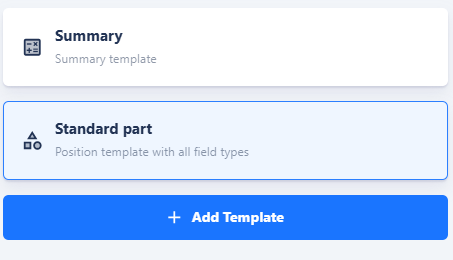
Within a package, calculations are organized using templates. Each template is a collection of fields and formulas for a specific calculation type, for example:
-
Standard item
-
Small part
-
Special coating
A template defines which fields are queried, how they are calculated, and which notes are displayed.
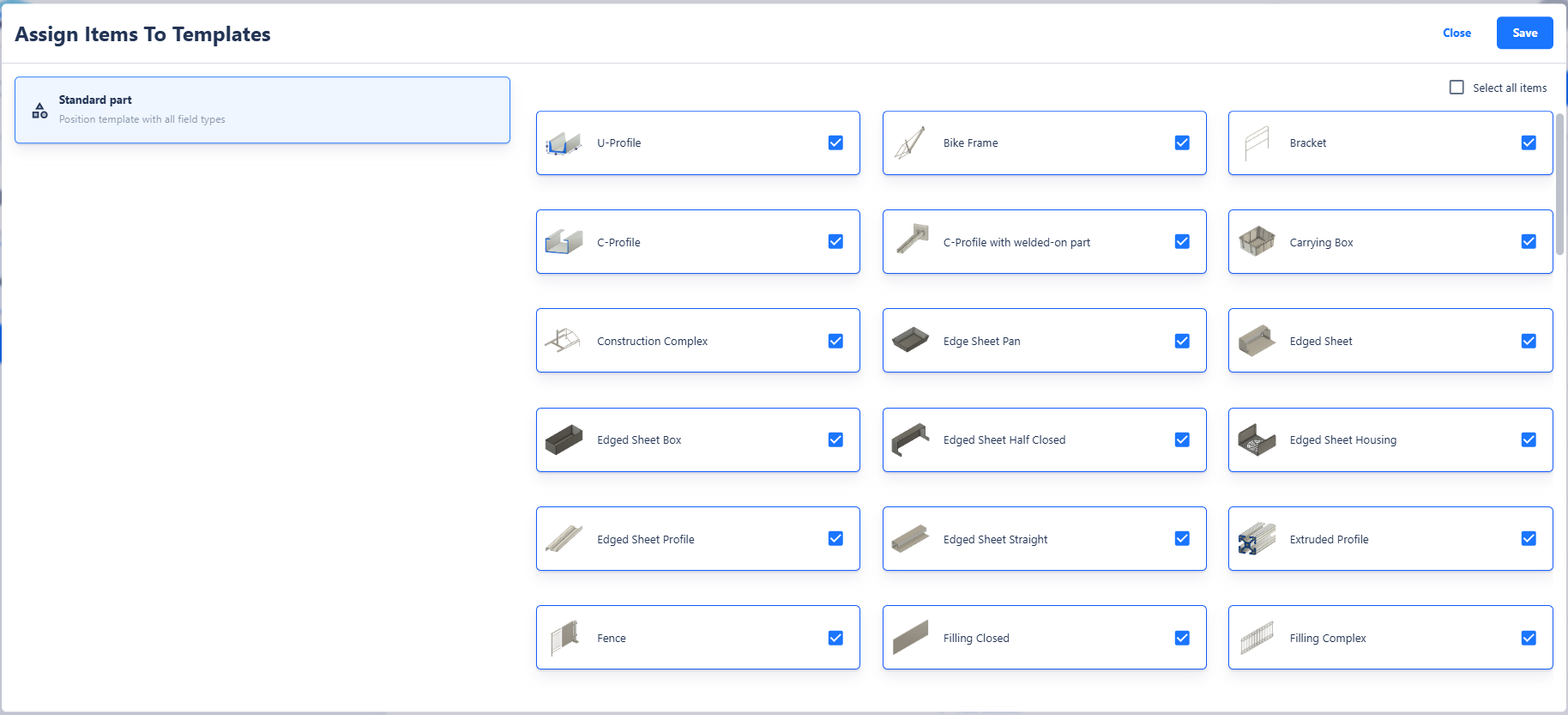
Item Assignment
Each item is assigned to exactly one template. The standard position is assigned automatically, while other templates must be assigned manually using the "Link Items to Templates" button. This ensures that each item uses the appropriate template for its calculation, while multiple items can share the same template.
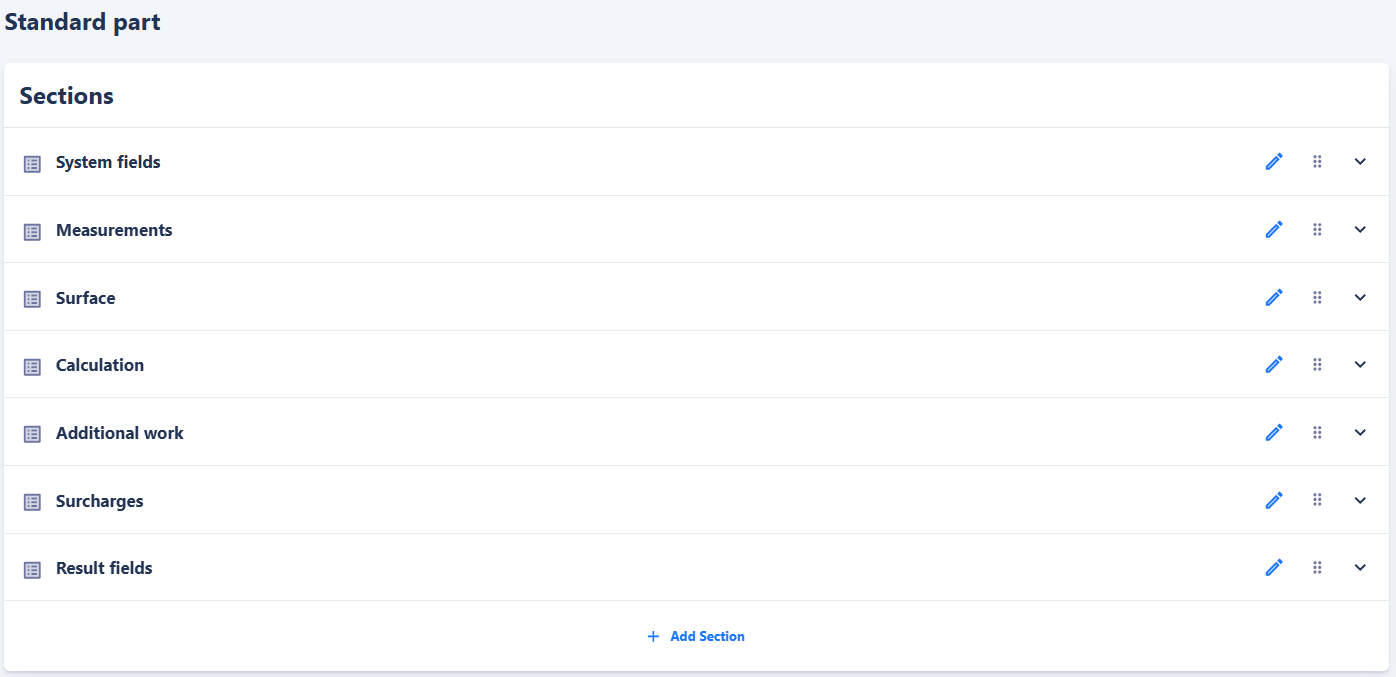
Sections Within Templates
Templates can be divided into sections to group fields thematically. Sections help keep the calculation logic organized. You can add, move, and rename sections. Fields can also be moved between sections, for example, to group surcharge fields or additional costs in a separate section.
This structure makes it easier to organize complex templates and ensures that users see information clearly structured in the Calculation Editor.
Standard Item Template
The Standard Item Template is the central template for individual items. It contains the fields and calculation logic needed for most items in the calculation, such as length, width, height, color, or material costs. Each position in the calculation is initially represented using this template, ensuring that calculations for each item are performed consistently.
Summary Template
The Summary Template is a special template that consolidates all items in a calculation. It is not a template for individual positions but summarizes the overall results of the calculation. Its fields can be found in the Calculation Editor under "Surcharge Fields."
An example of a field in the Summary Template is "SUM_POSITION_PRICE", which automatically calculates and inserts the sum of all positions in the calculation. You can then apply surcharges to this value.
Fields
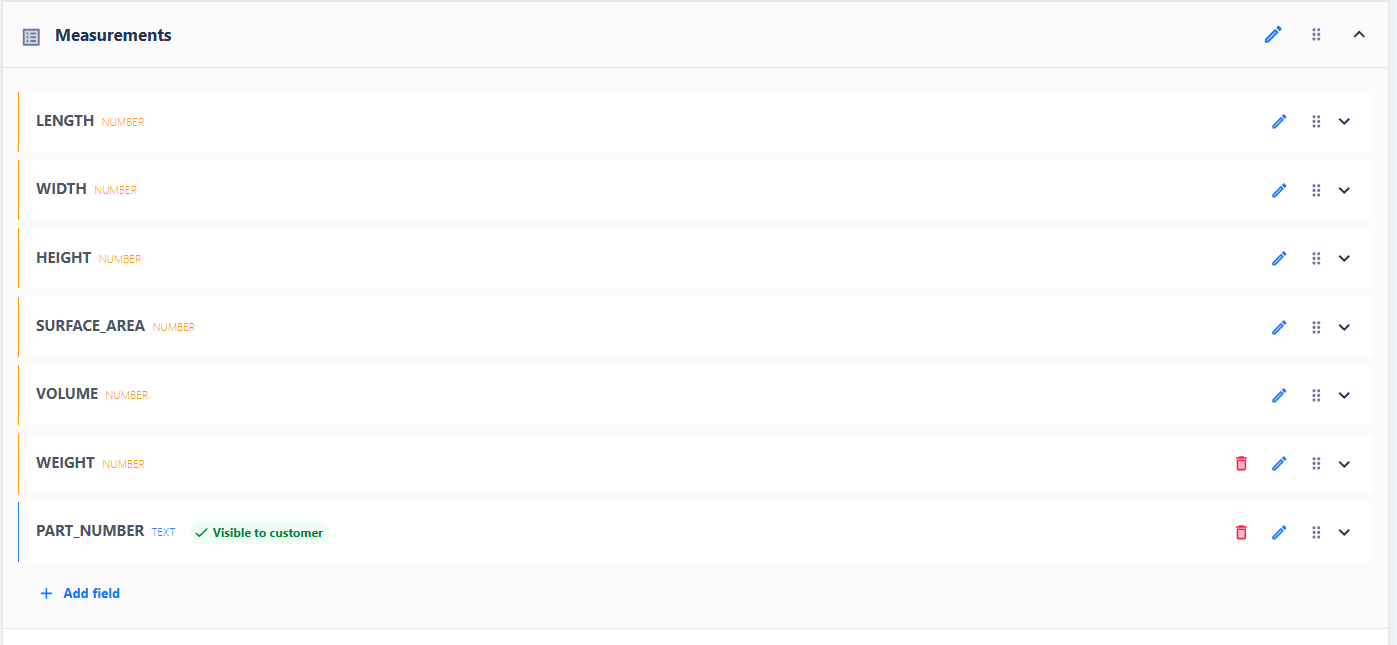
Fields are the fundamental building blocks of a template. They can serve as input fields for the user or contain calculations.
System Fields
Some fields, such as QUANTITY and PRICE, are required by the system. These fields cannot be deleted but can be optionally hidden. System fields are used to capture inputs or calculate results necessary for the calculation.
Field Types
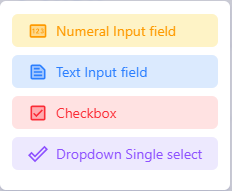
You can create fields in various types:
-
Numeric: Numerical values such as length, width, or weight
-
Text: Free text information
-
Checkbox: Yes/No query
-
Dropdown: Selection from a list of predefined values
Editing Fields
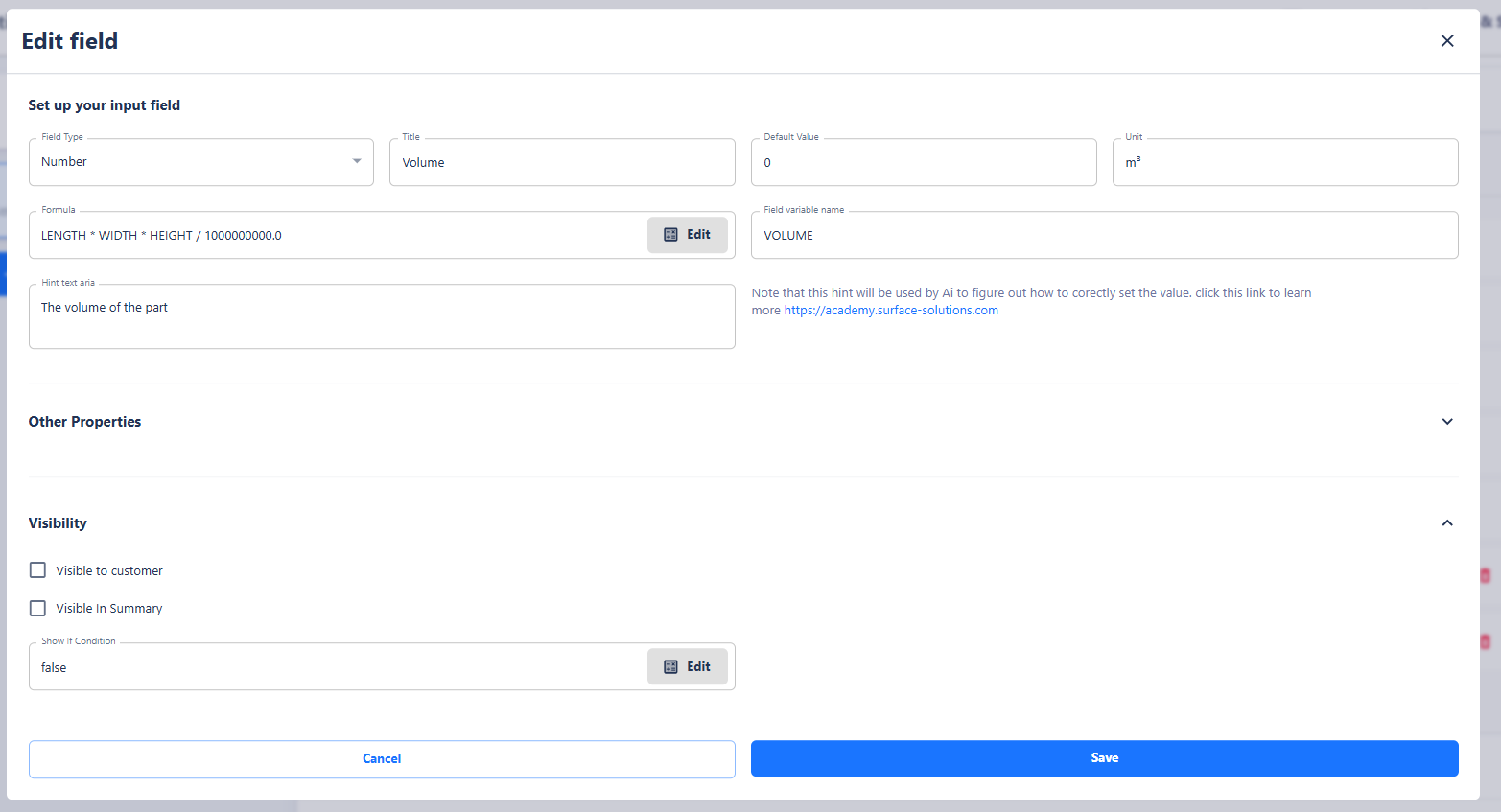
You can edit a field using the pencil icon. The following properties can be defined:
-
Title and default value
-
Unit (e.g., kg, €, €/m²)
-
Formula, if the field should be calculated
-
Visibility, for example, is visible to the customer in the offer or PDF export
-
Visibility condition, which uses formulas to control whether a field is displayed
Fields without a formula serve exclusively as input fields for the user.
Formulas
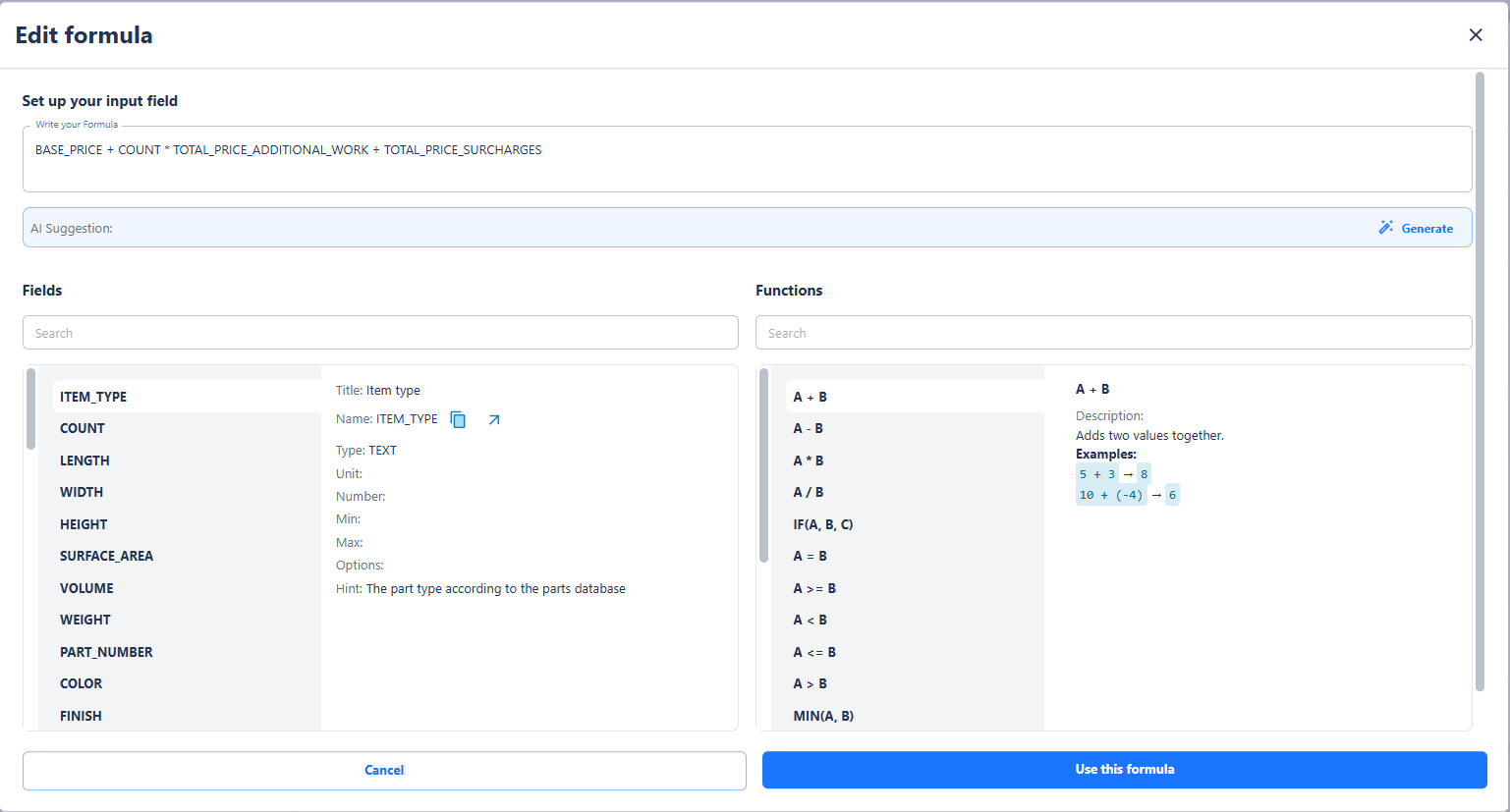
Formulas allow calculations to be performed dynamically. They are defined similarly to spreadsheet programs and can include operators and functions, such as:
-
Basic arithmetic: Addition (+), Subtraction (–), Multiplication (*), Division (/)
-
Conditions: If-Then
-
Comparison operators: >, <, =
-
Logical operators: and, or, not
Formulas reference other fields within the same template, enabling complex calculations such as price determination, material requirements, or surface area calculations.
Examples of formulas include:
IF(QUANTITY > 100; 0.9; 1.0)
LENGTH * WIDTH * HEIGHT
QUANTITY * UNIT_PRICE
Notes
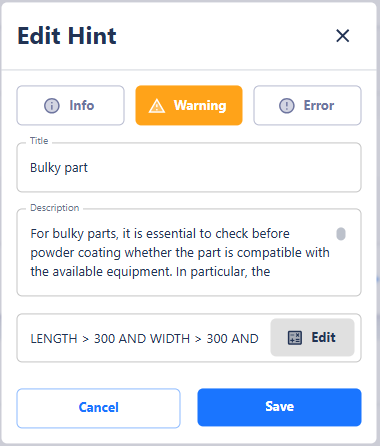
Notes are used to alert users to specific conditions or special considerations.
- Notes can be of the type Information, Warning, or Error.
- They appear at the bottom left of the position in the Calculation Editor.
- Their display can be controlled using formulas, so that notes are only visible under certain conditions.
Example: A note could appear when the quantity of an item exceeds a defined value.
Test Function
The test function allows you to simulate a template. All fields, including hidden ones, are displayed so you can check whether the formulas work correctly and if the results meet your expectations. The simulation does not save any data; it is solely for reviewing and validating the calculation logic.
Summary
The Calculation Definition is a powerful tool that gives you full control over your calculation logic.
-
Packages bundle all templates and provide organization-wide calculation logic.
-
Templates define the structure and calculations for individual items or calculation types.
-
Fields capture inputs and calculations, allowing complex computations through formulas.
-
Notes inform users about specific conditions.
-
The Test Function offers a safe way to review templates before using them in practice.
With this structure, you can work flexibly and transparently, handle complex calculation scenarios, and ensure both user-friendliness and consistency in your calculations.
Item Database
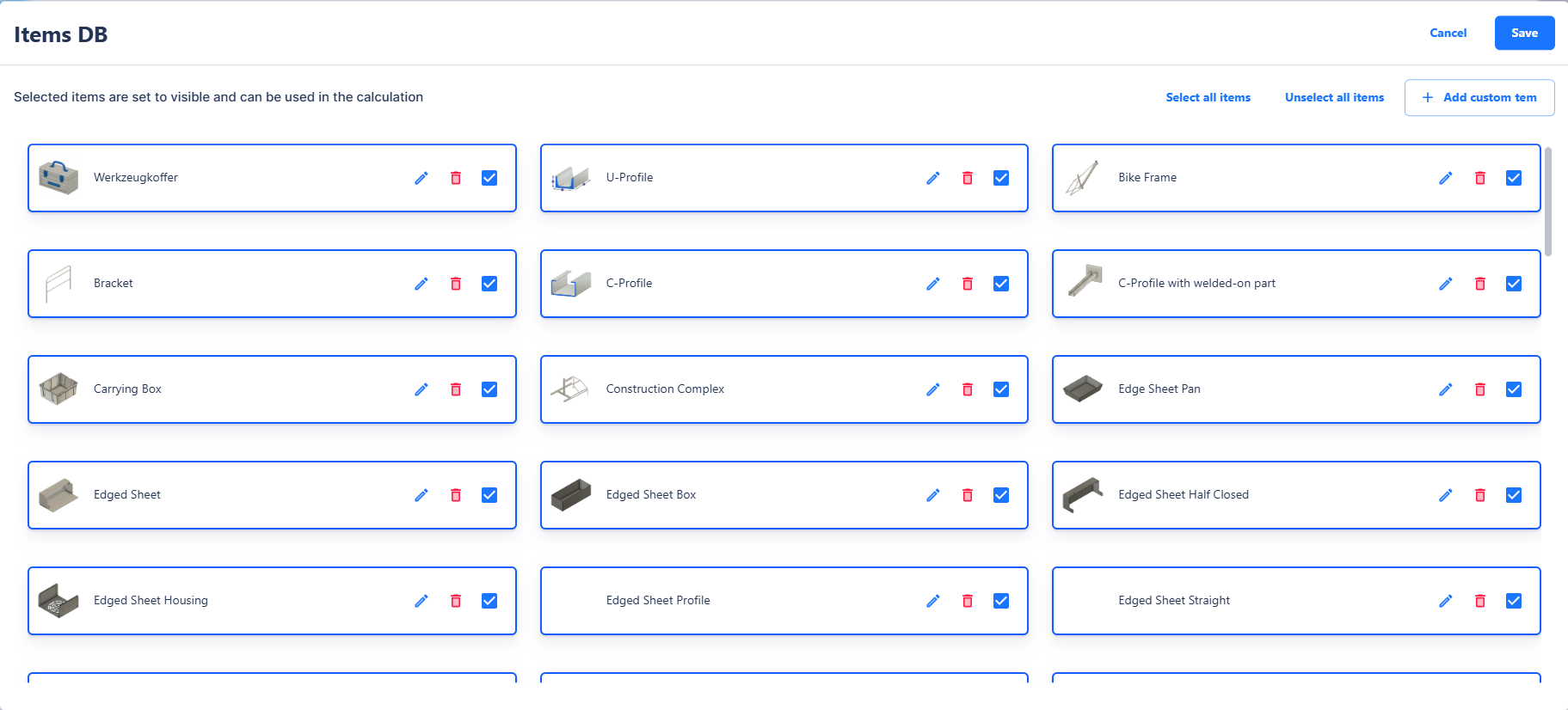
The Item Database in Surface Solutions is a central tool for managing all items in your company. It is independent of packages and available to all users within the organization.
The database contains both pre-made standard items and custom items created by you. Each item can be individually customized, including its name, article number, image, and visibility. Using the visibility checkbox, items can be hidden if needed, so they do not appear in the Calculation Editor.
Creating and Editing Items
New items can be created directly through the Item Database. You assign:
-
Item Name
-
Article Number for unique identification
-
Image for easier recognition
Existing items can be edited or deleted at any time. Changes automatically affect all calculations in which the item is used.
Formula Overrides
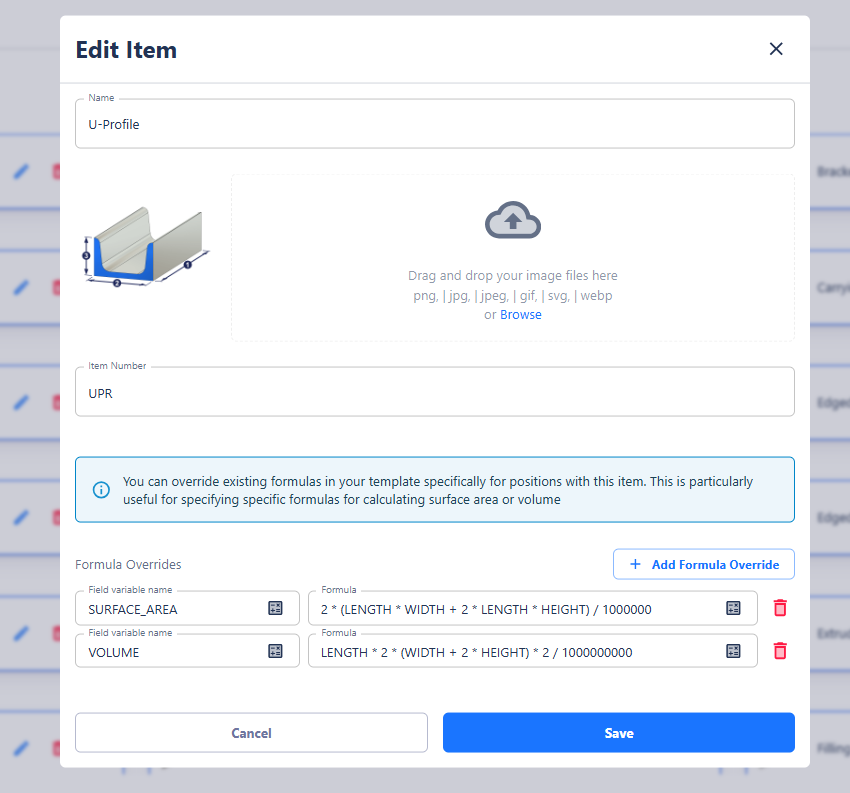
A key feature of the Item Database is formula overrides for individual items.
If a template in the Calculation Definition contains a field, e.g., volume, the standard formula may not be suitable for certain items due to differing geometries. Examples:
-
A U-profile has a different surface area than an L-profile or a sheet metal box.
-
A rim requires its own volume and surface area calculation.
In such cases, you can assign a custom formula override for each item. The following rules apply:
-
The variable name must match exactly with the variable name in the template for the override to be applied.
-
Multiple overrides per item are possible, e.g., volume, surface area, weight, etc.
-
If a formula is incorrect, for example, because required values are missing, the standard template formula is automatically used again.
Formula overrides affect only the calculation. Users do not see additional fields in the Calculation Editor—the values are simply calculated based on the item-specific formulas.
Integration into the Calculation Editor
Once an item is assigned to a position, the formula override is applied automatically if it exists. Otherwise, the standard formula from the template is used. This allows you to perform individual calculations for different items without having to adjust the template for all positions.
This ensures that complex item geometries are calculated accurately, while the calculation logic remains consistent and transparent.
Summary
The Item Database allows you to:
-
Manage all items of your organization, independent of packages
-
Create, edit, and delete items
-
Define visibility in the Calculation Editor
-
Set formula overrides for specific items
-
Perform individual calculations for different geometries, e.g., volume, surface area, or weight
-
Automatically apply item formulas in the Calculation Editor, with fallback to standard formulas in case of errors
With the Item Database, you can fine-tune the calculation logic at the item level while ensuring that your calculations remain reliable and transparent.